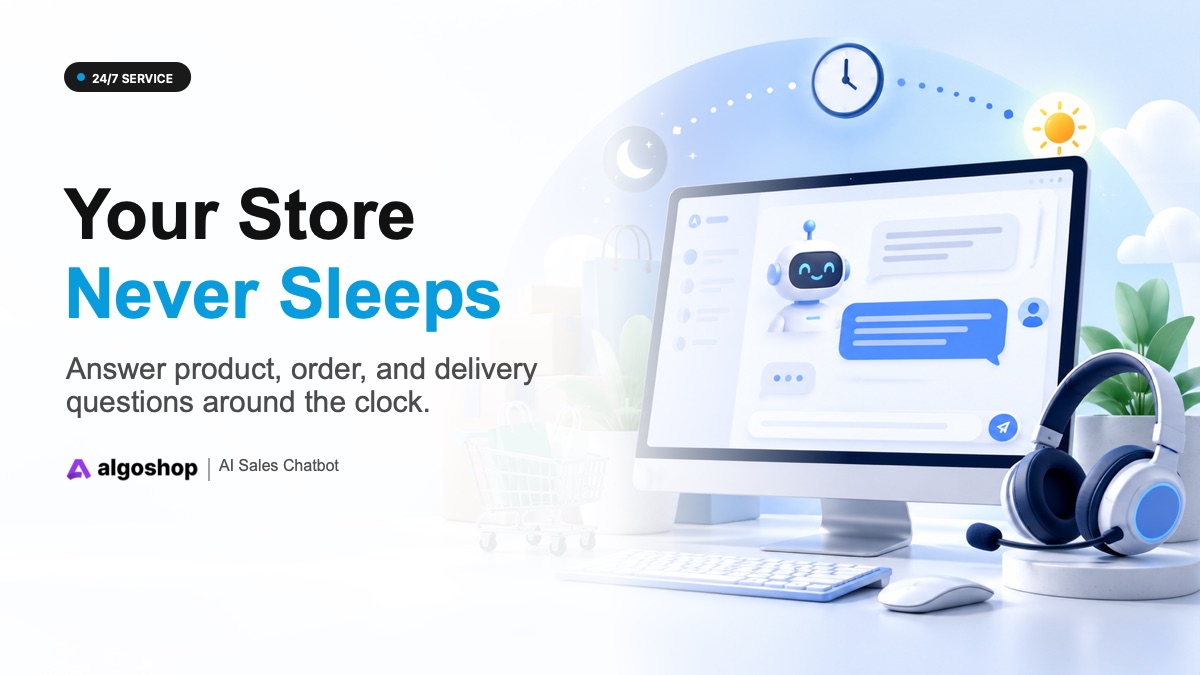
Most of the talk about AI in e-commerce is about the storefront. For operations teams, the more useful question is simpler: where does the team lose hours every week, and which of those hours can software take back?
In many Shopify stores, a surprising share of that time goes into customer conversations that repeat themselves. Where is my order? Does this come in a larger size? How long does shipping to Austria take? Can I still change my address? In this post we look at how an AI sales chatbot handles that work, using Algoshop AI Sales Chatbot as the example.
Where the Time Actually Goes
Before adding any AI tool, it helps to look at what the team answers every day. In most stores, a few categories make up the bulk of incoming messages:
- Order status: "Where is my order?" messages (often called WISMO) arrive in waves after every sale and every carrier delay.
- Product questions: Sizing, materials, compatibility, and which variant fits a specific use case.
- Policy questions: Shipping times, return windows, and discount rules.
- After-hours traffic: Shoppers in other time zones who write when nobody is online.
- Scattered channels: The same question arrives through site chat, WhatsApp, Instagram DMs, and Messenger.
Each of these takes a minute to answer once. The real cost comes from answering them hundreds of times, from switching between inboxes, and from the sales that are lost when a shopper has to wait until tomorrow for a reply.
What Algoshop AI Sales Chatbot Does
Algoshop is an AI chatbot and live chat app for Shopify that also supports WooCommerce. It carries the Built for Shopify badge and is rated 4.9 on the Shopify App Store at the time of writing. Its pitch is that a chatbot should help sell, not only deflect tickets. Most of its features also take repetitive work off the team:
- 24/7 answers from your own store data: The assistant syncs your product catalog and a knowledge base of FAQs and policies, so it answers product, shipping, and return questions in the context of your store.
- Self-service order tracking: Shoppers enter an order number or email address and get the shipping status pulled from Shopify. Algoshop says this removes up to 80% of repetitive "Where is my order?" tickets.
- Multilingual by default: It detects the shopper's language and replies in it, which covers international traffic without a second support shift.
- One assistant for social channels: Through the official Meta API, the same assistant answers WhatsApp, Messenger, and Instagram messages and can reply automatically to comments on social posts.
- Human handoff and live chat: Complex or high-value conversations are escalated to your team during the live-support hours you set. Agents see the full chat history and browsing context instead of starting from zero.
- Proactive outreach cards: Based on shopper behavior, it can show product recommendations, cart reminders, free-shipping progress bars, countdowns, and discount games. Shoppers can pick variants and add items to the cart without leaving the chat.
- Analytics: A dashboard reports conversations, product clicks, the revenue the assistant contributed, recovered carts, the most common questions, and where shoppers drop off.
Why Operations Teams Should Care
Customer chat looks like a marketing or support topic. In practice, a large part of it is operations work in disguise.
- Order status questions are logistics questions. When shoppers can check tracking themselves, the people running fulfillment get fewer interruptions while receiving, picking, and packing.
- Recurring questions are a data source. If shoppers keep asking about one size, a restock date, or a delivery time, that says something about your assortment, your stock levels, or your product pages. A weekly look at the top questions is cheap research.
- Handoffs with context save the second conversation. When a ticket does reach a person, they can see what the shopper already asked and viewed, which cuts the back-and-forth.
- Coverage without more headcount. Evenings, weekends, and other time zones are handled without building a support rota.
Setting It Up Without Creating New Work
An AI assistant is only as good as what it knows. A short checklist before going live:
- Sync the product catalog and check that titles, variants, and descriptions are accurate.
- Add shipping times, the return policy, and your FAQ to the knowledge base, in the wording your team already uses.
- Turn on order tracking so WISMO questions are answered automatically.
- Set live-support hours and decide which conversations should always go to a person.
- Match the assistant's name, avatar, and colors to your brand.
- Review the most common questions and drop-off points once a week, and fix the underlying cause, not just the answer.
Pricing at a Glance
Algoshop has a free plan and three paid plans, each paid plan with a 7-day free trial. Prices as listed on the Shopify App Store in November 2026:
- Free: Up to 100 AI messages and 100 live chat messages per month, analytics dashboard, custom chatbot logo and avatar.
- Starter, $39.90/month: Up to 1,000 AI messages per month, AI order and shipping tracking, 1 GB knowledge base.
- Essential, $79.90/month: Up to 3,000 AI messages per month, plus AI chatbots for WhatsApp, Messenger, and Instagram.
- Ultimate, $199.90/month: Up to 10,000 AI messages per month, unlimited product sync, and no "Powered by" tag.
Annual billing saves about 17%. The message quota is the number to watch, so estimate your monthly conversation volume before choosing a plan.
The Other Half: AI in the Back Office
A storefront assistant handles the conversation. The questions it surfaces often lead back to inventory: products that sold out, restocks that arrived late, delivery promises that depended on a purchase order. That is the half of the store we work on.
Logistified forecasts demand per product and location, turns the forecast into purchase orders with MOQ and pack sizes, and handles receiving and transfers. Through MCP, assistants like Claude or ChatGPT can query live inventory data and, from the Enhanced plan, create purchase orders or receive stock. Used together, one AI keeps shoppers informed while the other keeps the shelves stocked, so the chatbot has fewer stockouts to explain.
For a closer look at how Logistified handles forecasting and purchasing, the Algoshop team wrote a detailed review of Logistified.
Try Algoshop AI Sales Chatbot
If repetitive customer questions take up too much of your team's week, you can install Algoshop from the Shopify App Store and start on the free plan. More details are on algoshop.ai.