Shopify makes it easy to sell products. It is much harder to manage products that are built from other products: bundles, kits, gift sets, manufacturing batches, pre-assembled goods, and multi-part products.
The problem is simple: the storefront sells the finished product, but the warehouse needs to protect the components. If the component stock is wrong, the store can oversell a bundle even when the finished product still looks available.
The Problem: Bundle Inventory Is Not One Number
A kit might contain three base products. A manufactured item might require raw materials, packaging, labels, and pre-assembled sub-components. A product set might include one hero product and several accessories.
If those relationships live in a spreadsheet, the inventory picture becomes fragile. Teams have to manually subtract component stock, remember what each finished product consumes, and reverse the right quantities when orders are refunded or canceled.
Who Needs BOM Logic?
- Bundle sellers: Stores that sell product sets where every sale consumes multiple components.
- Makers and manufacturers: Brands that assemble finished products from raw materials or sub-assemblies.
- Food, beauty, and craft brands: Teams that need recipes, packaging components, and batch-aware work.
- Multi-location teams: Merchants that need component availability to stay accurate across warehouses or stores.
- Operations teams moving beyond spreadsheets: Anyone who needs traceability instead of manual stock math.
What a Good Bundle Workflow Needs
A reliable workflow starts with a Bill of Materials, or BOM. The BOM defines which components are required to build or sell a finished product, and how many units of each component are consumed.
- Component-level stock tracking: Every sale should affect the real materials behind the finished SKU.
- Multi-level BOMs: Kits should be able to contain other kits or sub-assemblies.
- Refund and cancellation handling: Component stock should be restored when the order flow reverses.
- Work orders: Production teams need a structured way to assemble, disassemble, and track pre-built goods.
- Cost visibility: Merchants should understand the true component cost of each finished product.
How Assemblified Helps
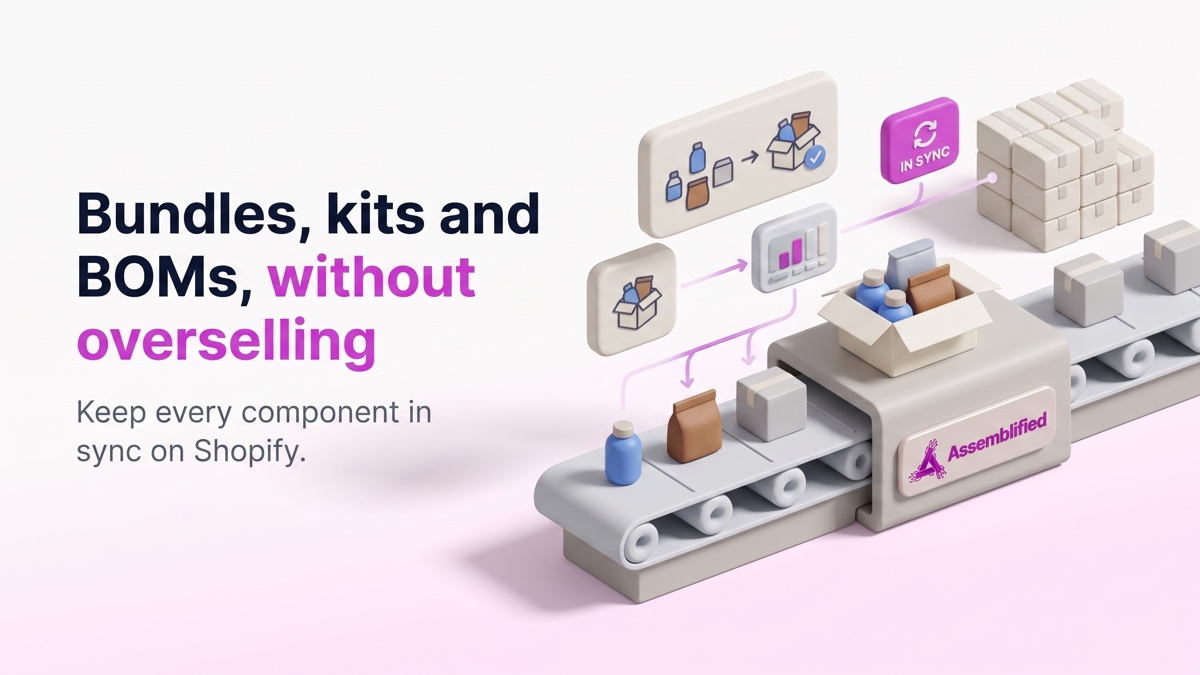
Assemblified brings Bill of Materials management directly into Shopify. Merchants can define product recipes for simple kits, complex bundles, and multi-level assemblies.
When an order is placed, refunded, or canceled, Assemblified keeps the connected component stock aligned with the real operational movement. Instead of relying on a separate spreadsheet, teams can manage the relationship between finished goods and materials inside the Shopify workflow.
For teams that pre-build inventory, Assemblified also supports production-style workflows such as work orders, material allocation, disassembly, and meta information tracking. This makes it easier to understand what has been built, what materials were used, and what inventory is actually available to sell.
Planning Beyond Today's Orders
Bundle inventory is not only about today's stock adjustment. It is also about future demand. If one bestseller consumes the same component as three other products, raw material planning needs to account for all of those relationships.
Assemblified integrates with Logistified, enabling raw-material demand forecasting based on bundle sales. That connection helps merchants move from reactive component checks to more structured material planning.
Try Assemblified
If you sell Shopify bundles, kits, or manufactured products, you can test Assemblified on the Shopify App Store and replace manual component tracking with BOM-driven inventory logic.